Scams & Fraudulent Schemes
Fourteen scam types. One operating logic. This section teaches you to recognise the structure, so you can spot threats that do not exist yet.
She Fell for Three Completely Different Scams
Sunita was 52, worked in HR, and considered herself street-smart.
Over 18 months, three things happened to her.
A recruiter contacted her on LinkedIn with a high-paying remote role. She paid a "background check fee" to process her application. The job never materialised. She lost ₹6,000.
Six months later, she received a video call from two men in police uniforms. Her Aadhaar number had appeared in a money-laundering case. She needed to pay a "compliance deposit" to avoid arrest while the investigation proceeded. She stayed on the call for four hours, alone and terrified. She transferred ₹2.2 lakh.
Eight months after that, a message arrived from someone her cousin had forwarded to a group chat. A relative abroad was in hospital and needed emergency funds until insurance processed. She sent ₹18,000 via UPI. The relative did not exist.
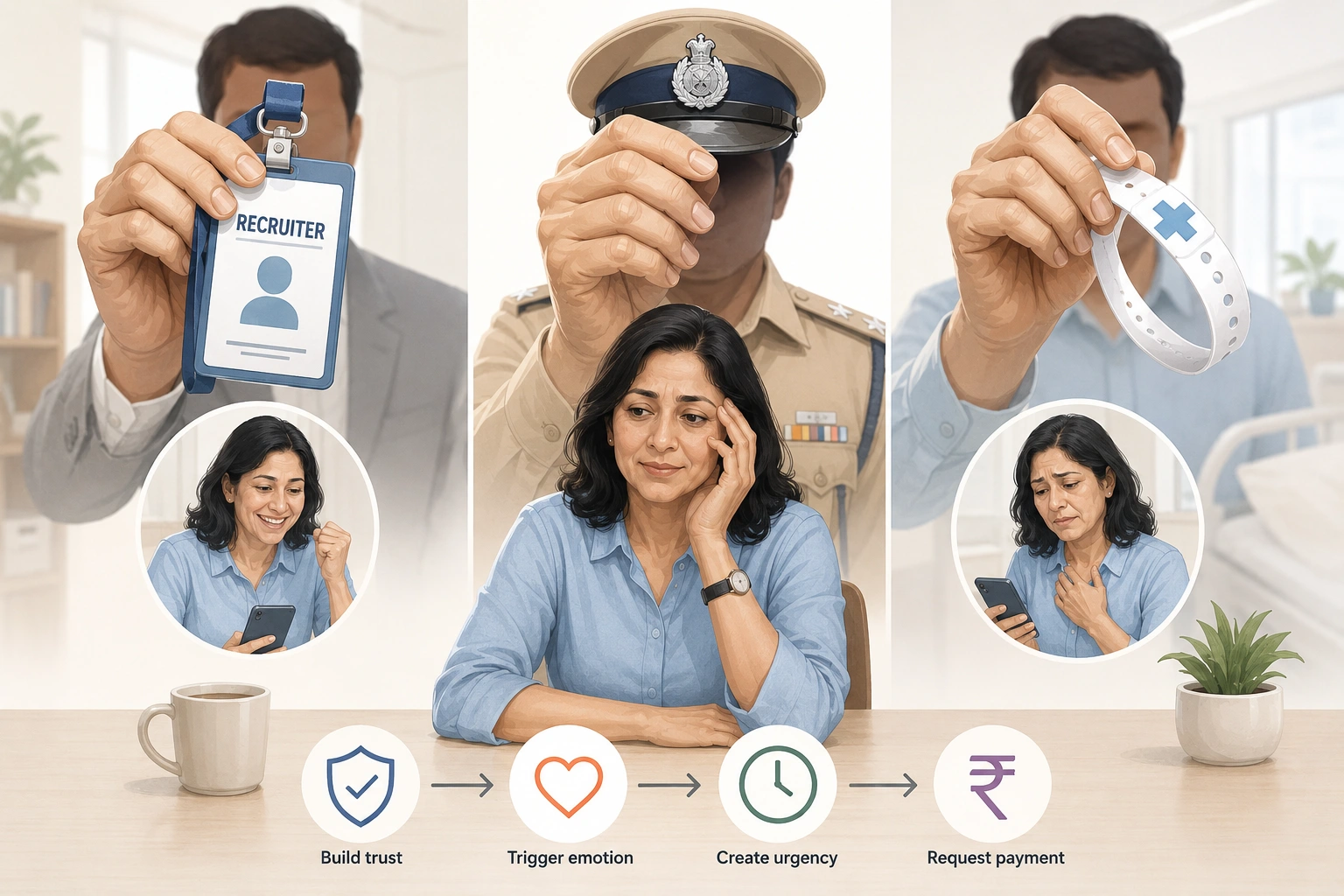
Three scams. Three completely different stories. Three sets of emotions: hope, fear, family obligation.
Sunita believed each one was a unique, isolated incident. She blamed herself separately for each. She did not see what they shared.
Every one of them ran on the same four moves.
Build plausibility. Trigger an emotion that bypasses thinking. Create time pressure. Request an untraceable payment.
The disguises change. The architecture does not.
What Is Actually Happening: Scams Are Not Random
These are not opportunistic tricks. They are repeatable industrial processes.
₹20,800 crore
lost to cyber fraud in India in 2025 - a 38% rise on the year before.
That figure does not include unreported cases, which researchers estimate are 7 to 10 times higher than what gets filed.
Source: Indian Cyber Crime Coordination Centre (I4C) Annual Report, 2026Every Scam Runs the Same Playbook
Across all 14 scam categories in this section, the underlying structure is the same: establish credibility, trigger an emotion, apply time pressure, collect payment through an irreversible channel. The disguise changes. The playbook does not. Recognising the structure is more durable than memorising warning signs for individual scam types.
Anyone in a Transitional Moment
Scammers do not pick victims randomly. They identify people at high-decision moments: job searches, relationship changes, financial stress, bereavement, home purchases. Nearly half of fraud victims were targeted during a documented life transition. The vulnerability is not stupidity. It is timing.
Scam Compounds Run Like Corporations
Southeast Asia alone has an estimated 300,000 people working in scam compounds, many trafficked into the work against their will. These operations have HR departments, shift schedules, performance targets, and script libraries. What feels like a personal attack is a managed industrial process.
Most Victims Never Report
An estimated 86% of fraud incidents go unreported, primarily because of shame. Victims blame themselves for being deceived. This silence keeps the real scale invisible, prevents others from being warned, and lets the same operations keep running. Falling for a professional operation designed by experts is not a personal failure.
Now Try It From the Other Side
Every scam, no matter how new it looks, runs on one of these 14 structures.
Below are 5 scenarios you probably have not encountered before, drawn from emerging fraud types. For each one, identify the category it belongs to and the psychological lever it uses.
After all 5, the architectural logic behind each one is revealed - including why a fake AI companion scam and a pig-butchering romance scam are structurally identical despite looking nothing alike.
Work through all five scenarios to see the structural insights.
What That Just Showed You
1. The costume changes. The structure does not.
A fake AI girlfriend running a pig-butchering(online relationship and investment fraud) script and a romance scammer on WhatsApp are architecturally identical. Both invest weeks in building emotional attachment before any money request appears. Both use distress to override the victim's pause instinct. The technology delivering the scam is irrelevant. The emotional sequence is fixed.
When you see a new scam format, stop asking "have I heard about this specific type before?" and start asking "what emotion is this triggering, and what does it want me to do next?"
2. Every scam has a single point of failure - the pause.
Scam architects know that a thinking person is a dangerous person. The entire structure: the urgency, the fear, the time limits, the emotional escalation, is designed to prevent one thing. A pause.
The moment you stop and say "let me verify this through a different channel" you have broken the most critical part of the scam's mechanism. Not every step. Just one. That pause is the intervention.
3. Shame is part of the design, not a consequence.
Scams that involve embarrassing circumstances, romantic deception, or financial greed are structured to make victims feel too ashamed to report or talk about them. This is not accidental. Silence is an operational requirement. The less victims speak, the longer the same script runs on the next person.
4. Life transitions are targeting signals.
Job searches, deaths in the family, new home purchases, relationship changes - these are not coincidences. Scammers actively scrape obituaries, property records, job boards, and social media for these signals. You are not targeted because you were careless. You are targeted because a dataset flagged you as reachable at a vulnerable moment.
5. Pattern recognition transfers to scams that do not exist yet.
The 14 categories in this section cover every major structure in operation today. New scams will appear with different technology, different contexts, and different emotional hooks. They will still run on one of these 14 structures, and they will still use one of a small number of psychological levers. Learn the structure once. Recognise it forever.
Three Things Worth Doing Before You Continue
1. Name the emotion before you act.
The next time you receive an unexpected message that makes you feel fear, urgency, excitement, or obligation, pause and name the emotion out loud before responding. That naming step takes three seconds. It is also the scam's only point of failure. Practice it now, before it matters.
2. Create a one-call verification habit.
For any request involving money, personal information, or account access, make one outbound call to a number you already have saved - not a number provided in the message. Call the bank, call the relative, call the employer. Verification through a second channel breaks the scam at the credibility stage. It costs two minutes.
3. Talk about the ones that worked.
If you or someone you know has been caught by a scam, say so. Specifically. The more detailed and specific the account, the more useful it is to others. Shame is what keeps the same scripts running for years. Speaking is a protective act for everyone who hears it.
One Question Before You Continue
Sunita was deceived by three completely different-looking scams. What did they share?