Health, Medical & Pharmaceutical Scams
The Call That Sounded Legitimate
Preethi had been with the same health insurer for six years. She knew her policy number by heart.
When her phone rang one Tuesday, the caller introduced himself as Rajesh from customer care. He used her full name. He sounded professional. He said all policyholders needed to re-authenticate their details before Friday or coverage would be paused.
Then he read out her policy number, her insurer's name, and her last claim amount - to the rupee.
She thought: a scammer would not have that information.
Rajesh guided her through "re-authentication." He needed her Aadhaar number, then an OTP sent to her phone. She shared both.
That evening, she received a message about a hospitalisation claim filed that afternoon. Rs. 68,000. A two-day stay at a private hospital in a city she had never visited.
What Actually Happened
Preethi was not careless. She was prepared against.
Policy numbers, insurer names, and claim amounts are available through data breaches and phishing kits sold on dark web forums. The caller used her real data as proof of legitimacy, not because he worked for her insurer, but because correct personal details make people stop questioning.
This is social engineering - using personal information and emotional pressure to make someone act against their own interests.
The OTP was the real target all along. Sharing that six-digit code gave the fraudster full access to her insurance account. He filed a fake hospitalisation claim using forged documents before she knew what had happened.
Three things worked together: a believable "system upgrade" framing, a Friday deadline for urgency, and accurate personal details for trust.
Statistics and Evidence
45% of Insurance Fraud Uses Identity Impersonation
Over 45% of insurance fraud in India involves identity-based impersonation, including fake hospitalisation claims filed with the victim's Aadhaar and policy details.
200,000+ Health Fraud Reports
The FTC received over 200,000 health-related fraud reports in a year. India's numbers are proportionally significant and rising with digital health adoption.
96% of Online Pharmacies Operate Illegally
96% of online pharmacies identified by regulators operate without valid prescriptions or sell counterfeit products.
Only 1 in 7 Victims Report Health Fraud
Only one in seven victims of health fraud reports the incident to any authority. Embarrassment, confusion, and delayed realisation all contribute.
Counterfeit Drugs Make Up 10% of Supply
Counterfeit medicines represent about 10% of the global drug supply. In markets with weaker regulation, the share is higher.
Fake Prescription and Medication Scams
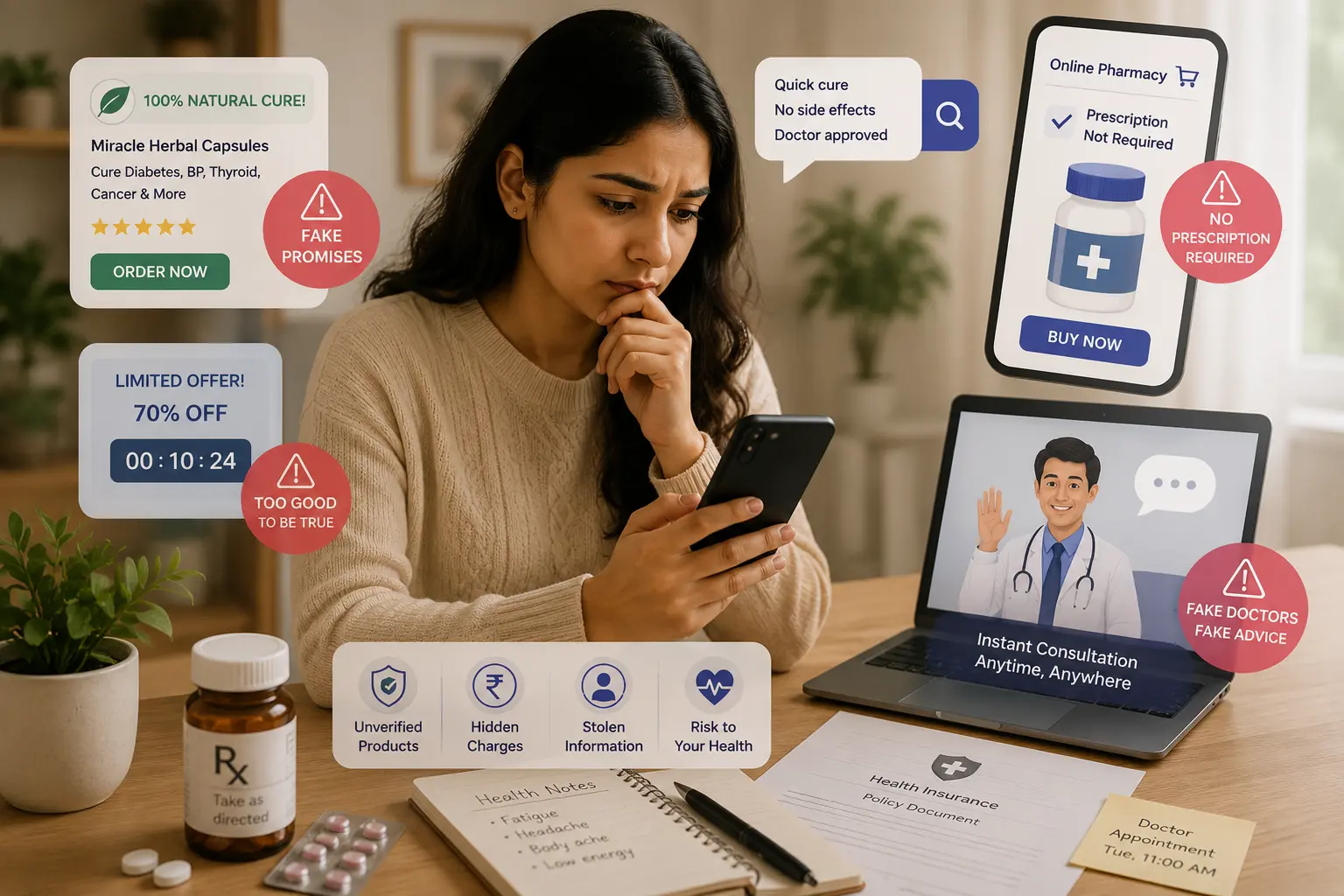
Fake online pharmacies mimic real ones with professional layouts, trust seals, and review sections. They even ask for a prescription - which makes them seem more legitimate, since real pharmacies do the same.
What arrives ranges from nothing, to placebo tablets, to the wrong dosage, to pills contaminated with unrelated substances. The packaging often looks identical to the original. A person managing diabetes or hypertension who unknowingly takes an inactive substitute may blame worsening symptoms on their condition - delaying real treatment.
In India, the CDSCO maintains a database of licensed pharmacies and approved drug manufacturers. If an online pharmacy cannot provide a valid drug licence number, that alone is a clear warning. Price is not a reliable signal - fraudulent pharmacies often price products near market rate to avoid suspicion.
Medical Device Fraud and Unlicensed Practitioners
A device that gives false glucose readings can cause dangerous insulin decisions. Medical device fraud in India commonly involves glucose monitors with inaccurate readings, physiotherapy devices with unsupported medical claims, and gadgets marketed as home diagnostic tools. The device does not just fail to help - it actively causes harm.
Unlicensed practitioners often fill gaps where access to mainstream healthcare is limited. They listen carefully and offer treatment that feels personal. That emotional attentiveness is real - even when the credentials are not. People consult them not out of foolishness, but because they found someone who seemed to care.
Before consulting any practitioner, verify their registration on the National Medical Register maintained by the National Medical Commission of India. Registered doctors have a verifiable NMC number. Asking for it is not rude. It is appropriate.
Health Insurance, Billing, and Telemedicine Fraud
Billing fraud from within the system involves charging for procedures not performed, upcoding a consultation to a more expensive procedure, or submitting the same claim to multiple insurers. From the patient's side, this shows up as coverage limits exhausted for services never received.
Telemedicine fraud accelerated significantly after 2020. Fraudulent platforms collect patient information and insurance details under the guise of care, using unqualified people or automated scripts. Others function as prescription mills, issuing prescriptions for controlled substances without any real evaluation.
The most common patient-facing version is the insurance callback scam - exactly what Preethi experienced. A legitimate insurer will never ask for your OTP over a call. OTPs exist specifically to prevent third-party access. Any caller asking you to read one aloud is attempting to gain unauthorised entry to your account.
Fake Health Apps and Diagnostic Platforms
Fake diagnostic apps claim to detect conditions using your phone camera or microphone - skin cancer detection, blood glucose estimation, cardiac arrhythmia diagnosis - with no clinical validation. A person who trusts an app that falsely clears a worrying symptom may delay the medical visit that would have caught something real.
Data collection apps carry a quieter risk. Health data is among the most valuable personal information categories on the grey market. A free "symptom checker" may be harvesting your diagnosis history and medication list - data sold to brokers or used to enable identity theft.
Supplement sales apps deserve specific attention. Many present as health assessments, but the assessment always concludes you need a product sold on the same platform. It is not a medical tool. It is a sales funnel dressed as healthcare.
Before trusting any health app, check whether it appears on the CDSCO's approved digital health tools list or the NHA's Ayushman Bharat Digital Mission registry.
The Psychology Behind Medical Scams
Medical scams work on the same emotions every time.
Fear disables critical thinking. When someone is worried about a diagnosis or afraid of losing coverage, the brain prioritises action over analysis.
Hope works just as powerfully. The promise of relief from chronic pain or financial burden is hard to dismiss - and skepticism can feel like self-sabotage.
Trust in professional signals - a government-looking seal, a formal letterhead, a confident caller with correct personal information - triggers trained responses of deference. Fraudsters study exactly which signals produce that response and replicate them.
None of these are character flaws. They are human responses to real conditions. Understanding them is the beginning of real protection.
Interactive Learning: Symptom or Sales Pitch?
The exercise below shows six real-world health messages - the kind that appear as WhatsApp forwards, app notifications, or social media posts. For each one, decide: legitimate medical information, or sales manipulation?
What the Simulation Showed
Many health scams do not look like scams. They look like concern. They look like advice.
The safest question is not: "Is this true?" It is: "Is someone trying to make me feel something before I think?"
Manipulative messages tend to share these traits:
- They promise certainty and immediate results.
- They create urgency to prevent verification.
- They use authority without evidence - vague expert references, unnamed doctors.
- They appeal to fear or hope rather than informing a decision.
Legitimate medical information behaves differently. It acknowledges uncertainty, encourages professional consultation, avoids miracle claims, and focuses on informed decisions rather than immediate action.
Trustworthy health information rarely pressures you. The moment you feel rushed or overly hopeful, it is worth slowing down.
Reporting Medical Fraud
Reports help investigators identify patterns, disrupt criminal networks, and warn future victims. Many victims assume reporting will not help - and that assumption benefits fraudsters.
If you encounter suspected medical fraud:
- Report counterfeit medicines to the relevant drug regulator.
- Notify your insurer immediately if you suspect policy misuse.
- Report suspicious websites, apps, and advertisements to consumer protection authorities.
- Inform banks and payment providers if financial information was shared.
- Save screenshots, receipts, and messages before deleting anything.
Quick reporting often reduces damage. In some cases, fraudulent claims can be stopped before payment occurs.
Four Things Worth Doing
1. Verify medical professionals before treatment.
Check practitioner registration through official medical licensing databases before sharing health information or accepting treatment. A professional should never object to verification.
2. Treat health-related urgency as a warning sign.
Pause whenever someone claims immediate action is required to avoid losing coverage, treatment access, or health benefits. Urgency is one of the most common manipulation tools.
3. Use only trusted pharmacies and health platforms.
Purchase medications only from licensed pharmacies and use health apps that clearly identify their regulatory compliance and privacy practices. Professional appearance alone is not proof.
4. Never share authentication codes.
Do not share OTPs or verification codes with anyone claiming to represent a hospital, insurer, pharmacy, or government agency. Legitimate organisations do not need these codes from you.
Knowledge Check
Aman receives an advertisement on social media for a wearable health device. The ad claims the device can detect over 150 diseases instantly, has been recommended by leading doctors worldwide, and is available at a special discount that expires in three hours. The website provides no regulatory approval information and no verifiable clinical studies. What is the strongest warning sign?