Romance & Emotional Manipulation
Before anyone steals your money or your dignity, they steal your trust. This module explores how bad actors engineer intimacy, manufacture affection, and weaponise loneliness to gain total control over another person.
The Hook: The Man Who Felt Real
Meera was 54 years old, recently divorced, and living alone in Pune for the first time in her adult life.
She had joined a Facebook group for people learning watercolour painting. It was just a hobby. A way to fill the evenings.
A man named "James Harrington" sent her a friend request. His profile showed a handsome, silver-haired civil engineer working on infrastructure projects in Aberdeen. He had photos of weekend hikes, a golden retriever, and what looked like a close-knit family.
He had noticed her artwork in the group. He left a kind comment. Then a private message.

Within three days, he was messaging her every morning:
"Good morning, Meera. I hope your brushes are ready."
It felt warm. Playful. Different from anything she had felt in years.
Within three weeks, he told her he was falling in love with her. He said he had never met anyone who understood him the way she did. He talked about retiring early and moving to India. He asked which city she thought was best for a quiet life together.
Meera told her sister. Her sister was worried. Meera told her sister she was being paranoid.
Six weeks in, James hit a problem. His construction equipment had been seized at a port in Malaysia due to a paperwork dispute. He needed $4,200 to release it. Just for ten days. He would return it the moment he landed in Pune.
Meera sent it.
Then there was a customs fee. Then a medical emergency. Then a wire transfer that "bounced" and needed to be re-sent. Over four months, Meera transferred 22 lakh rupees to various accounts. Her savings. Her emergency fund. A portion of the settlement from her divorce.
The day she ran out of money, James disappeared.
There was no James Harrington. There never had been. His photos had been generated by an AI system that creates consistent, believable faces that do not belong to any real person. His messages had been scripted by a team of operators running dozens of "relationships" simultaneously from a compound in Southeast Asia.
Meera had not been naive. She had been targeted by professionals.
What Is Actually Happening: The Architecture of Fake Love
These are not opportunistic scams. They are engineered systems. Every step of what happened to Meera has a name, a method, and a statistic behind it.
$3B
lost to romance scams in the US alone in 2025 - more than double the figure from 2024.
These are not rare crimes. They are industrial operations run by organised syndicates, often using trafficked workers.
Source: LexisNexis Risk Solutions Government, 2026$5.8B in the US, 2024
Pig butchering investment fraud - where long-term trust is built before financial extraction - cost US victims $5.8 billion in 2024. Average individual loss: over $150,000.
Only 46% Spot AI Photos
Only 46% of people correctly identified AI-generated photos in a controlled test. Reverse image search no longer protects against AI-generated personas that have never appeared online.
$2.8B from Over-60s
People aged 60 and older reported more than $2.8 billion in investment fraud losses in a single year - the highest of any age group. Loneliness and life transitions are targeted deliberately.
1 in 4 Targeted
1 in 4 online daters globally has been targeted by a dating scam. Norton blocked more than 17 million dating scam attacks in just the final three months of 2025 alone.
Catfishing, Fake Personas, and AI-Generated Identities
A catfish is a person who creates a fictional identity online to deceive another person into a relationship. The method has existed for decades. What has changed is the technology behind it.
Traditionally, catfishers stole photos from real people's social media profiles. They were catchable. A reverse image search could expose them in seconds.
That window is closing.
AI can now generate photorealistic portraits of people who do not exist. Consistent across multiple angles, absent from any image database. A reverse image search finds nothing - not because the person is clean, but because they were never real.
Beyond photos, scammers use AI chatbots to maintain dozens of fake relationships simultaneously. Each appears personal. Each remembers details. The result is a scam that passes every casual check a person might reasonably make.
Love Bombing: Overwhelming Affection as a Control Tactic
The technical name for what James did to Meera in those first weeks is love bombing. It is a deliberate psychological tactic. The goal is not affection. The goal is dependency.
When someone floods you with constant attention, declarations of love within days, and talk of a shared future before you have even met, they are not expressing genuine feeling. They are building emotional debt. The more invested you feel, the harder it becomes to question what is happening.
The pattern follows the same arc every time: Idealisation (you are perfect, they have never felt this way), then Devaluation (warmth cools, you chase getting it back), then repeat or discard. Each cycle pulls you deeper in.
Pig Butchering: Long-Term Trust Before Financial Extraction
What happened to Meera is called pig butchering in the scam industry - from the phrase "fatten before slaughter." Build trust over weeks or months. Make the relationship feel real. Then introduce a financial crisis, an investment opportunity, or an emergency. Repeat the extraction until the victim has nothing left.
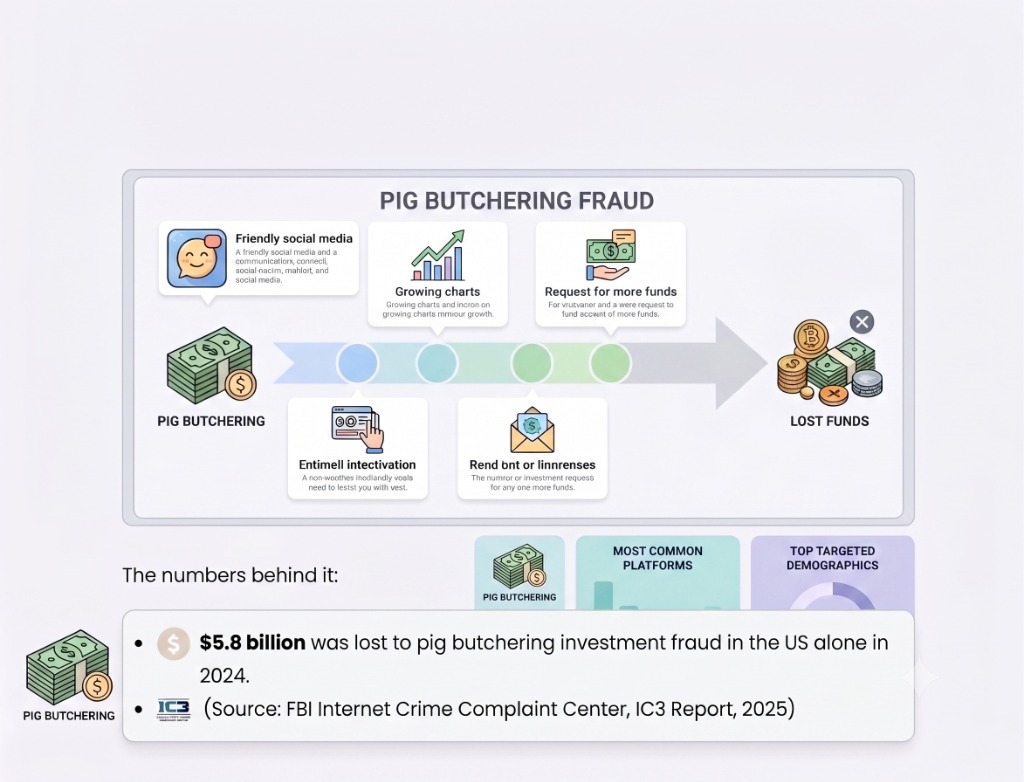
Global losses over four years are estimated to exceed $75 billion. (Source: University of Texas at Austin, Griffin and Mei, 2024). Investment fraud losses grew 66% year-on-year in 2024. Meera was not an outlier. She was statistically average.
Many of the people sending these messages are not free agents. Hundreds of thousands of people across Southeast Asia have been trafficked into scam compounds and forced to run these operations under threat of violence. (Source: United Nations, 2024)
Isolation from Friends, Family, and Sceptics
Isolation is not a side effect of emotional manipulation. It is a primary tactic. If the people who know you best are still in your life, they might ask the questions that break the spell. So they have to go.
It rarely looks like control. It looks like love. A small comment. A slight withdrawal of warmth when you make plans without them. A gentle criticism of a friend:
"She sounds like she doesn't want you to be happy."
Over time, your circle shrinks. The only person left who knows everything about you is the one running the operation.
Loneliness and Sympathy Exploitation
Scammers do not pick targets randomly. They look for signals.
Loneliness is the most targeted vulnerability. People who are recently divorced, widowed, living alone, or going through difficult transitions are disproportionately targeted. Not because they are weak. Because they have a genuine human need for connection that is currently unmet, and that need is visible.
Meera joined a hobby group. She was new to living alone. She was visibly navigating a life transition. From a targeting perspective, she was searchable, reachable, and emotionally open.
Sympathy exploitation works alongside loneliness. Once the emotional bond exists, the scammer introduces a crisis that triggers your empathy. A sick parent. An equipment dispute. A frozen bank account. A missed flight. Each crisis is designed to make you the person who helps. Because good people help. And scammers know that.
Why This Works on Anyone
Intelligence does not protect you from this. Scammers are not exploiting stupidity. They are exploiting the part of you that wants to love and be loved. That is not a flaw. It is the most human thing there is.
Recognising When a Relationship Is a Manipulation Construct
The hardest part about being inside emotional manipulation is that it does not feel like manipulation. It feels like love, or excitement, or finally finding someone who gets you.
Red flags only make sense in hindsight, or when someone outside the situation names them. Here is a way to name them while you still have time.
Working through the checklist does not mean you have been scammed. It means you are paying attention.
What That Just Showed You
1. Manufactured intimacy is faster and more convincing than real intimacy. Real relationships build slowly, with inconsistencies, different moods, friends you meet. Manufactured intimacy presents only warmth, only attentiveness, only exactly what you need. That perfection is the first warning sign.
2. Financial requests always come after emotional investment, never before. By the time money is mentioned, you are already emotionally committed. Saying no to the money feels like saying no to the relationship. That is the mechanism.
3. Isolation is a transaction, not a feeling. When someone pulls you away from the people who know you, they are removing the people most likely to end the operation. Anyone who makes your existing relationships feel like a threat is giving you information about their intentions.
4. These are industrial operations, not individual crimes. The person on the other end may themselves be a victim - trafficked into a scam compound and forced to run scripts under threat. The operation behind them is what targeted you.
Three Things Worth Doing
1. Be more curious about people who seem too perfect. A person who is always available, always warm, and never has a bad day is not a perfect match. They are a performance. Real people have texture and inconsistencies. Perfection is the warning sign, not a reassurance.
2. Treat any financial request from an online relationship as a full stop. The moment money enters a relationship that has not involved a verified in-person meeting, treat it as a manipulation attempt. The amount does not matter. Small requests are tests. They escalate.
3. Keep one person in your life who knows everything. The most powerful protection against emotional manipulation is someone who has permission to say "something feels wrong here." That person is your early warning system. Keep them close. Do not let a new relationship push them out.
One Question Before You Continue
In Meera's story, the scammer built a relationship for six weeks before mentioning money. Why is the length of that build-up important to how the scam works?